
Java, 1794–1811: Between Worlds
Echoes Without End

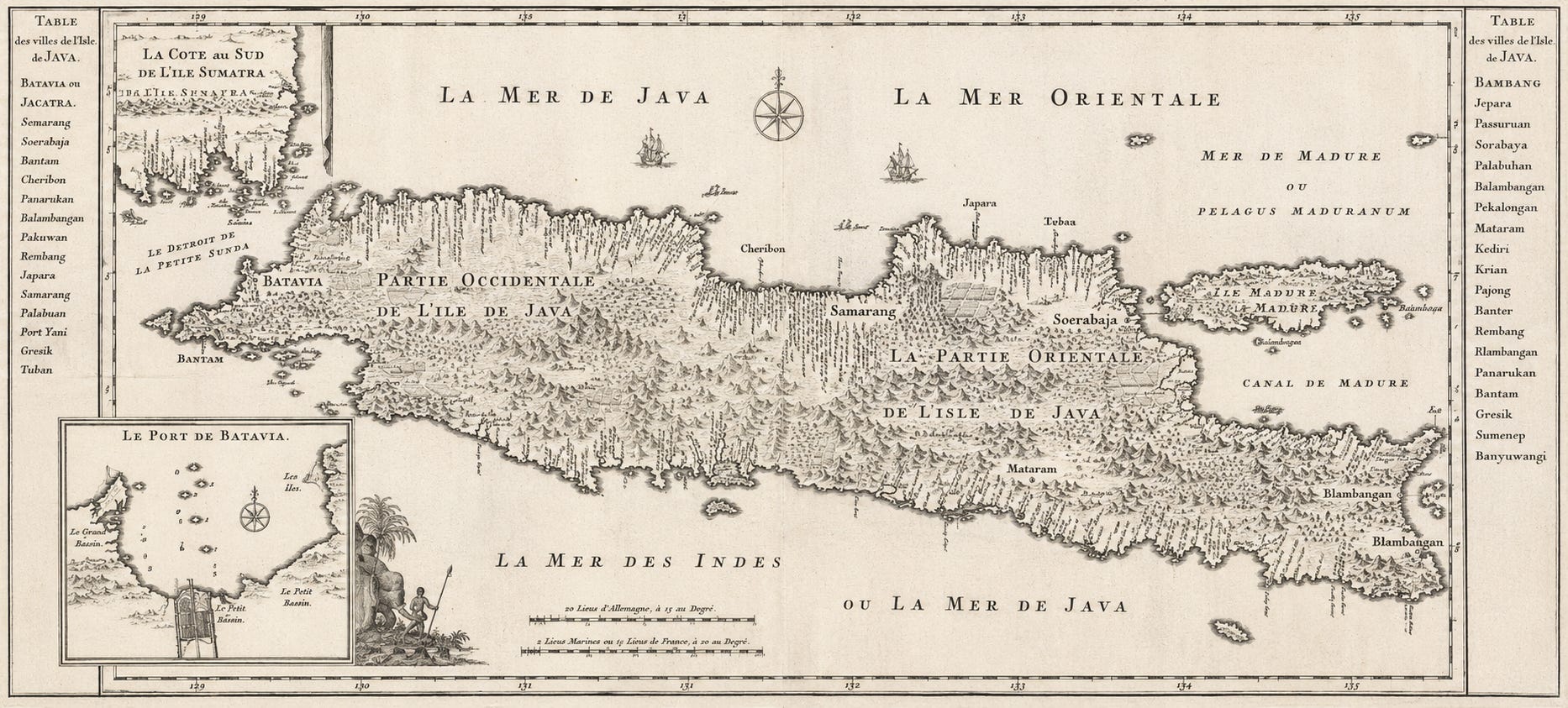
By the time Carl Borel arrived on Java, Semarang and Surabaya were already important trade and military centers connected to older Asian trading networks linking Java to China, India, Arabia, and the eastern archipelago. Dutch, Javanese, Malay, Chinese, and Portuguese creole could be heard in ports, markets, military compounds, and elite households.
Dutch authority depended heavily upon Javanese bupati (regents), aristocratic rulers who governed local populations while working alongside Dutch Residents and colonial officials. Regents were publicly honored yet remained subordinate within the colonial hierarchy.
These years were marked by growing instability. The Dutch East India Company collapsed in 1799 as Britain and Napoleonic France struggled for control over trade and empire. Political authority shifted repeatedly, and colonial officials faced increasing uncertainty. By the time Governor-General Herman Willem Daendels began strengthening roads, forts, and military defenses against a possible British invasion, tensions were already reshaping life on Java.
Arrival
Borel and Barbara leave the ship into the low-lying harbor. Javanese porters are unloading, while Dutch traders bark orders. Malay, Javanese, and Portuguese creole are among some other languages spoken in the harbor.
The couple take a carriage through the city to their new home. Borel sees cavalry marching, mounted officials and Chinese merchants crossing harbor roads. Barbara has difficulty adjusting her gloves damp with perspiration. She holds a perfumed handkerchief to her nose to minimize the smells.
The carriage follows a path along a canal that leads to a residential quarter with whitewashed villas, shuttered windows, red tiled roofs and lush gardens. At the church square stands a waringin (banyan) tree almost as wide as the church. The carriage pulls up a long driveway lined with frangipani (plumeria).
Borel holds Barbara’s hand as she steps out of the carriage onto a path with moss growing between the stones. They are greeted by a steward who lowers his head and introduces himself.
“Tuan and Njonja,” the steward says in simple Dutch, “My name is Kusuma.” He then points to a line of women wearing brown batik kains and white kebayas and men in batik sarongs with collarless shirts and head cloths.
“This is, Sarina the kokkie (cook), Dewi and Sari the baboes (housemaids), Wira the kebon (gardener) and Danar the djongo (house boy).” The servants lower their heads and do not make eye contact. Borel listens and repeats the names. Barbara looks down seeing bare feet. Only the steward wears sandals.
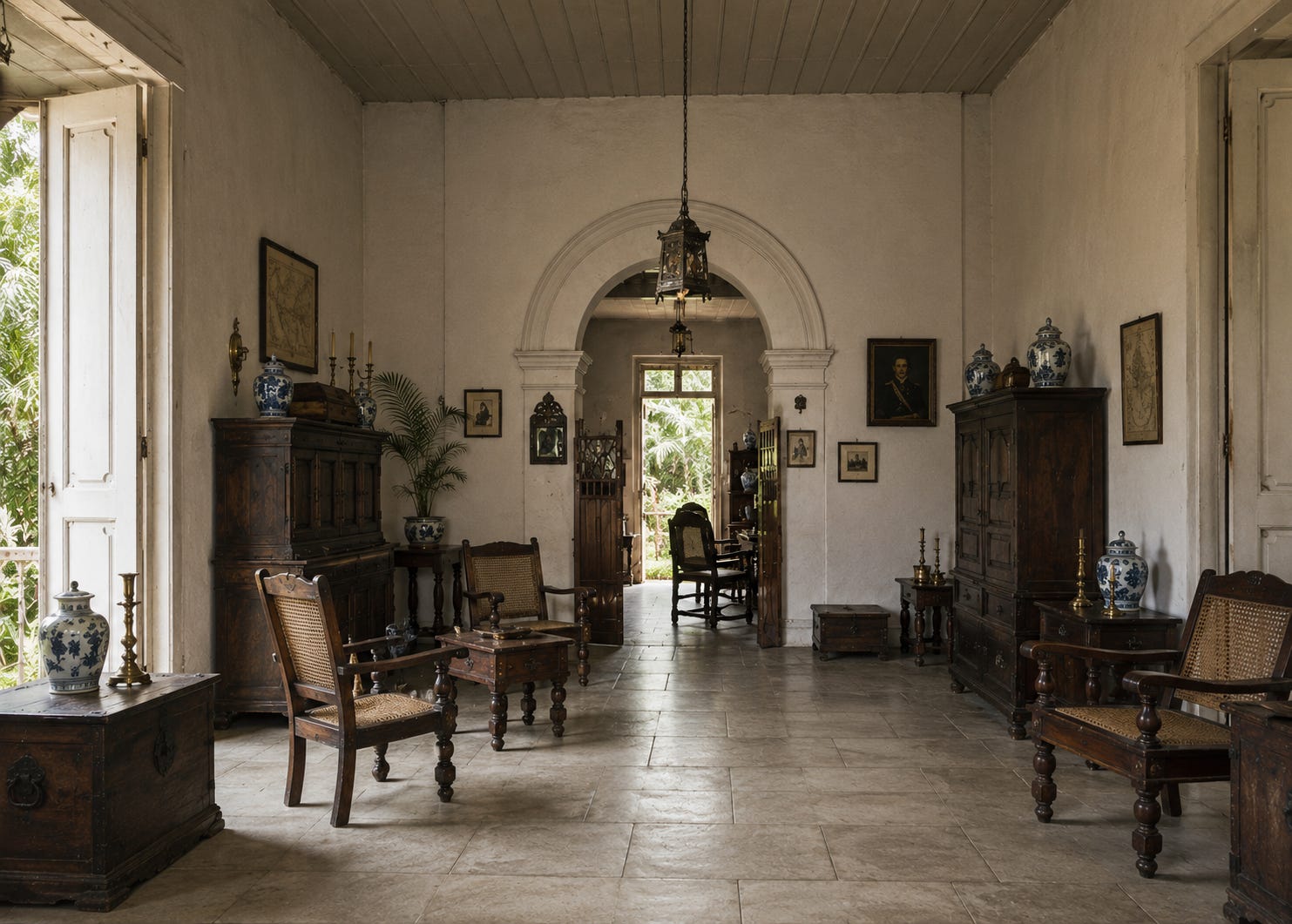
The couple steps onto the tiled veranda with rattan furniture and then into a dim gallery with high ceilings, teak tables, Dutch cabinets and blue and white Chinese porcelain vases. A gecko scurrying across the wall startles Barbara. She walks further inside towards their bedroom furnished with carved teak. White mosquito nets hang over the bed. With difficulty, she removes her gloves, bonnet, empire gown and undergarments all damp with perspiration.
Borel continues with the steward to the back of the grounds past the inner courtyard to the kitchen buildings and servants’ quarters. Dewi and Sari cross the courtyard quietly as the men return to the front veranda. The unfamiliar sounds, smells, and languages leave him slightly unsteady. Lists and instructions restore something familiar. Borel offers instructions for where to put the silver, paintings, books, and linens.
The steward leaves silently. Borel remains. Watching servants move through the house before a single trunk is unpacked, Borel senses that life here follows rhythms older than the Dutch houses and harbor offices built beside them. The servants require remarkably little instruction.
He returns to the inner rooms to find Barbara in a light house gown. He takes her by the arm urging her toward the veranda.
“Come smell the frangipani. It is sweeter at night.”
Lanterns appear along with the chirping of crickets as the tropical night settles.
The Resident’s Dinner
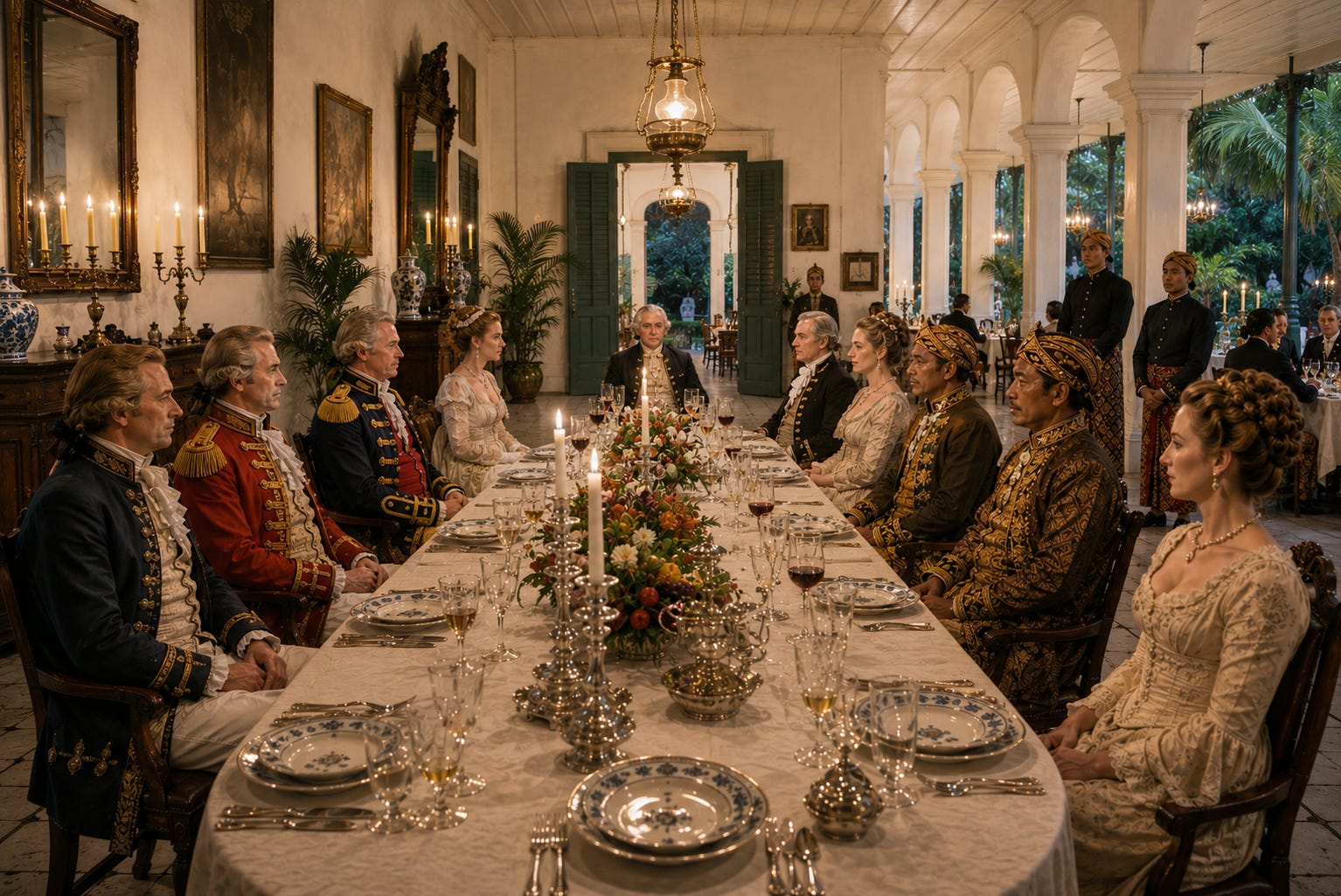
Borel and Barbara enter the long gallery with marbled floors and candelabras lighting the imported mirrors. They continue walking where a series of portraits of Governors-General and enter another gallery. A chamber ensemble from Makassar plays European salon music. Servants circulate refilling glasses. As they find their way between guests, Borel and Barbara see David laughing with a merchant, his hands resting on the back of a chair.
Just as Borel and Barbara reach David, a retinue of Javanese regents enter, wearing finely batiked kains, court jackets with gold thread, refined blangkons (headcloths), and krises with jeweled hilts. Their attendants follow carrying fans. Barbara admires their costume.
The regents greet Resident Van Hogendorp and Colonel Van Altena with a contained bow and perfect Dutch. Raden Adipati Wiranegara enters into conversation with the resident and colonel about court matters and rice yields. Fans move the air through the room and the Colonel tugs at his collar.
Colonel Van Altena says, “One forgets sometimes how elegantly Your Excellency speaks Dutch.”
“Your hospitality encourages practice,” says the regent, and then carefully sips his tea.
Borel admires how Wiranegara never tries to prove himself or compete for attention. He occupies authority effortlessly.
He then watches how David genially approaches Raden Adipati Wiranegara. He bows slightly and says, “Your Excellency is kind to indulge us. Java teaches languages faster than Europe does.”
The clang of the gong announces dinner. Between the potted palms are several long tables set with filigree Javanese silver, candelabras and Chinese porcelain. The guests wait for the resident to be seated.
As he approaches the center table, Van Hogendorp raises his glass and says, “Thank you, Your Excellency, Raden Adipati Wiranegara for traveling all this way. We honor your loyal cooperation.”
The regent places his fingertips briefly together. The resident then gestures for the colonel to sit next to him and the regent further down. The guests watch Raden Adipati Wiranegara move gracefully to his seat. Borel looks at Barbara and then at David.
After they are seated, the highest-ranking officers, senior VOC officials, prominent merchants and their wives sit next to the resident’s table while the other regents sit on the other side. Chairs scrape as the remaining lower-level officers (including Borel and David), VOC officials, merchants and their wives sit at tables according to their ranks. The officers suffer their European uniforms while their powdered hair softens in the humidity. Barbara looks over at the women. Their jewels sparkle in damp necklines.
Borel is seated next to the Assistant Resident Willem de Fretes. They easily engage in conversation, speaking Dutch with occasional Malay phrases. A servant replaces their plates.
“His Excellency understands these rooms very well,” de Fretes says.
“The resident?”
A slight pause:
“The regent.”
Borel watches the regent converse with measured calm. Servants refill wine. The laughter grows louder. He turns toward Barbara.
She says, “They perspire more than the Javanese.”
The orchestra softens and David’s laughter fades into the sounds of tropical insects outside.
Monsoon Season
The monsoons have arrived. It rains incessantly. The shutters rattle. Everything is even more damp and never dries. The smell of mildew concerns Barbara. Since the death of her firstborn, Carolina Adriana, from fever, Barbara often thinks of home.
Charlotte Elisabeth Piiron, named after Barbara’s favorite aunt, lies in her cradle. Barbara sits languidly on a settee. Dewi enters almost silently with a tray of tea and the biscuits Barbara showed the kokkie how to make. Dewi leaves the tray knowing Barbara likes to pour her own tea. The baboe backs away as silently as she entered.
Surprised to find a tray on the teak table, Barbara hadn’t noticed the servant enter. She pours tea into the blue China cup catching the leaves in a silver sieve. She reaches for a biscuit. After a few sips she bites into the softened biscuit and grimaces. “Can nothing be like it should be?” she thinks to herself.
The sound of a baby’s cry startles her awake. She arises quickly nearly knocking over the teacup. She hears baby Lotte, not crying but giggling. Barbara enters deeper into the house towards the back to the nursery.
There Dewi and Lotte are playing. Dewi covers Lotte’s face with a cloth and then lifts it quickly. “Iki aku!” she exclaims.
While pleased to find her daughter well and enjoying herself, something irritates.
“It’s Kuckuck!”
Dewi not having seen, turns towards Barbara and moves away from the crib.
“Playing with her is fine. Please use the German, Kuckuck, da bin ich,”
Dewi repeats with, “koe-koek, da bin ik.”
Lotte’s giggle eases the tension between the njonja and baboe.
Military Office
Borel is at a military office. He and a Dutch captain are in charge of generating the quarter’s shipping reports. Indo-European clerks work in an adjacent office. Borel is looking over a ledger absently holding down the damp paper that’s curling at the edges. His colleague, Maurits is reading and responding to correspondence. He is having trouble deciphering a letter from a shipping captain from Semarang and calls Louis, an Indo-European clerk, to translate. He then walks over to Borel holding a report.
“It has taken twice the number of inlander laborers to accomplish the task than would have been necessary with men from Europe,” he said, indicating the report. “An inlander will rest the moment you stop watching.” He let the paper fall back onto the desk.
Louis has entered and now stands waiting for his superior’s response. Nothing in his face or posture betrays that he has heard. Borel knows otherwise.
Without acknowledgment or greeting, Maurits holds out the letter.
“Translate this.”
“Orally, sir, or in writing?”
“Now. Then provide a written translation for the records.”
He wants to know at once how urgently a reply was required and sees no reason to explain himself to a clerk.
Louis translates the letter with ease.
Borel recognizes the act of humiliating. Uncomfortable, he looks neither at Maurits nor Louis. Later he would regret not having said anything.
Louis is invisible. Borel knows invisibility. Not because of race—but because of birth.
Carl Wilhelm
The Belgian doctor and a Indo-Euroepan midwife are there for the birth of Barbara and Borel’s third child. Borel had been overland for military inspections in the interior for the other two births. With Barbara’s frequent illnesses during this pregnancy, Borel made sure he would be home for this one.
Borel sits in the veranda in a light cotton shirt and linen trousers wearing slippers. He takes a sip of arrack. Three-year-old Lotte, with blonde curls like her mother, sits on his lap. Holding her father’s hand in a fist, she raises each finger then says a word in Javanese. Borel repeats the game, using her Javanese words. Then he does it a second time using the German equivalent. She giggles and they repeat the game over and over.
Hearing the doctor’s shoes tapping on the tile floor, Borel rises and puts Lotte on the chair.
He looks up anxiously as the doctor enters.
“It’s a boy,” he says with a smile.
Borel calls for Dewi to care for Lotte and follows the doctor into the bedroom. Barbara, very pale, dressed in a white linen nightdress lies against the pillows in bed. Tien, the midwife, is holding the tiny infant swaddled in soft cotton.
Borel reaches out and Tien hands him his son. He looks into the newborn unfocused eyes with tears in his own.
He says, “Willkommen auf der Welt, mein Sohn. Du sollst Carl Wilhelm heißen.”
(”Welcome to the world, my son. You shall be called Carl Wilhelm.”)
©2026 Astrid Berg
To be continued…