
The Larger Currents
Listening for Echoes

Where the Creek Meets the Ocean
I’m standing where the creek streams into the ocean. It’s my favorite place to watch. The ripples upstream become waves and then fan out into the sea. Ocean waves crash and alter the direction of the creek’s smaller waves. The waters mix, circling about, and in some places change direction. It’s hard to tell what was ocean and what originated as creek waters.
This scene appears more dramatic when the creek is wider, deeper and faster during the winter.
Children splash and ride boogie boards in the creek where it’s calmer. Out on the ocean, I see two SUP-ers paddling where the water appears still.
The Missing Centuries
I originally had planned two vignettes of the Württemberg line: Count Eberhard in the late thirteenth century and Duke Carl Eugene in the late eighteenth century. By leaving a 500-year gap I was skipping over too much history. I realized the missing centuries were not empty space but the story itself—those of war, arranged marriages for power and land, political intrigue, the Protestant Reformation.
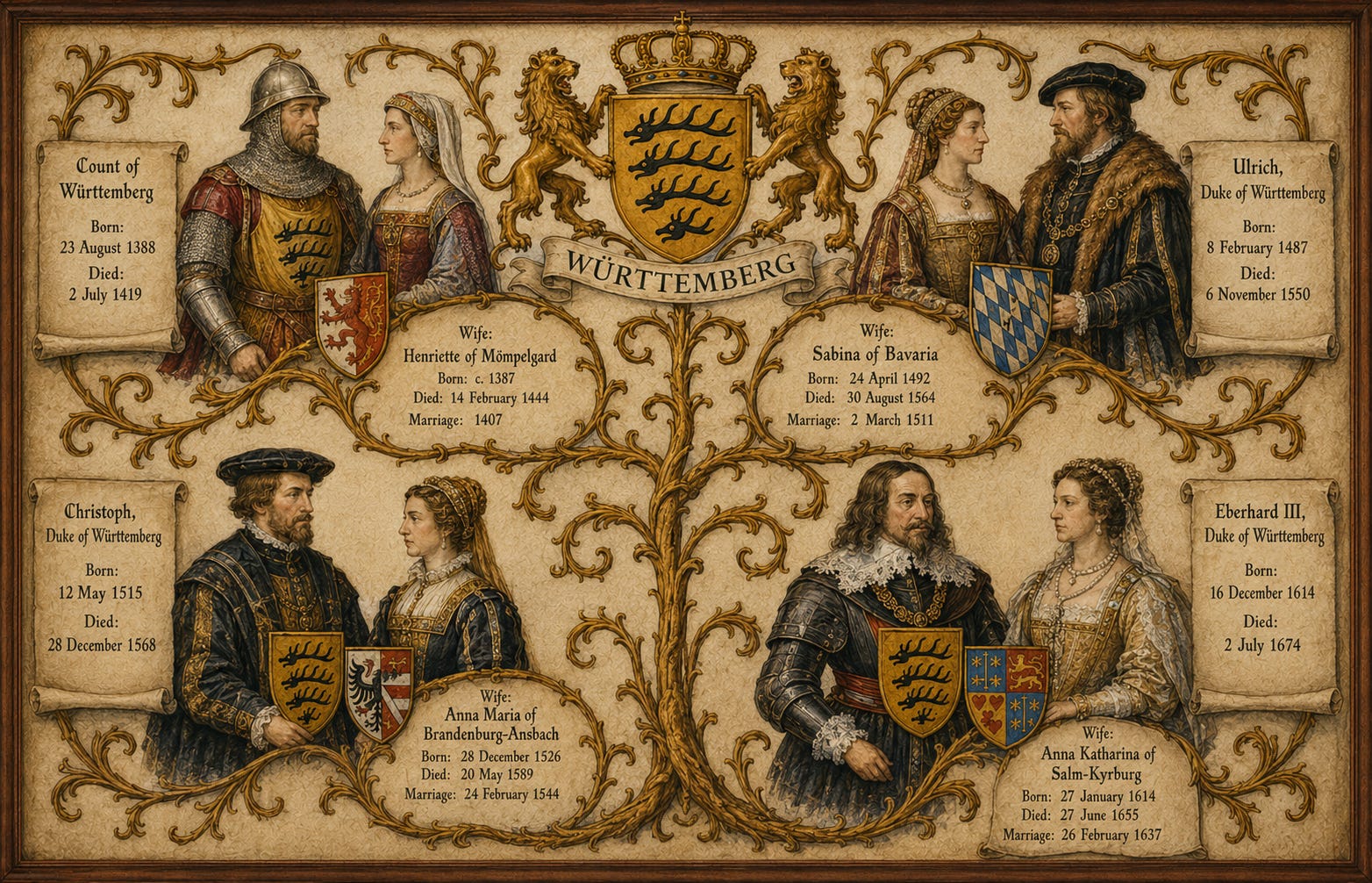
Within the Württemberg lineage portrayed—Eberhard and Irmengard, Eberhard IV and Henriette of Mömpelgard, Ulrich, Christoph, Eberhard III and Anna Katharina, Maria Augusta and Charles Alexander—the larger historical events became personalized stations along a historical arc.
My running question was: how did their lives shift from land-based community and shared belonging to religious upheaval, reform, war, and ultimately the world of performance, success, and display? I eventually began to think of this as two questions.
When Land Became Possession
When did land stop being lived with and become possessed?
The localized, kin-based communities, who lived in small settlements, were bound through kin and shared labor. In many places, land was not owned so much as used. Safety came from belonging. Survival was tied to seasons and cooperation. With generations of invasion and conflict came uncertainty and border enforcement of fixed territories held by ruling nobles, like Eberhard and Irmengard. They governed small and shifting territories within unstable alliances.
Castles were fortresses for protection. This can be felt in the vignette with Eberhard and Mechthild holding out in the castle, measuring the land and even in the practical wedding ceremony. The assurance of retaining land depended upon alliances of marriage and succession of sons. The tension to bear sons is felt in the vignette with Eberhard IV and Henriette of Mömpelgard.

The Discipline of Refinement
How did collective instability produce hierarchy, emotional restraint and refinement?
When land could not be held through succession, alliances needed to be made with other duchies or greater powers like the Habsburgs. Uncertainty and pressure to hold onto land took place through political intrigue and negotiation with more powerful landholders or war. Across generations, you see Ulrich and Maria Augusta write and receive letters that must be hidden. Eberhard III and Anna Katharina inventory losses, and displaced families pass the palace road after the Thirty Years’ War.
Religious ideology and practices were part of the political uncertainty and shifting alliances. Protestant reform also reshaped emotional culture where ritual expression became more restrained in some regions/courts.
For those, like the Württembergs who were aligned with the Reformation, there was greater value placed on self-control and inward discipline as shown in the vignette about Duke Christoph, where music and dance became more subdued.
Over time, embodied life was replaced by hierarchy and court structure. With that came rank, tighter protocol and surveillance of behavior. Community and cooperation turned into etiquette and social performance. By the time of Carl Eugene (story still to come), court life displayed excesses with women, art, learning, and extreme expenditures he could not afford.
The Duke is a product of centuries of historical movement and an endpoint of accumulated historical forces from belonging toward spectacle, image, and performance. But beneath the spectacle may lie insecurity, instability, and historical pressure.
What Remains in Me
While the stories and characters remain with me, they are not as close to my heart as the vignettes I wrote earlier about village and family life in Java, the Thuringian Forest and Middleburg where life felt warm, embodied and relational. In the Java stories, the damp, balmy air, and taste of the spices in their food remains with me. I feel their ease in relationship, like exhaling. In Middelburg and the Thuringian Forests, their closeness to earth and its life resonates with my gardening and walks near the ocean. I feel a belonging—less separation between self and other, whether it is people, animals, plants or the land itself.
While the noble court stories are fascinating and historically revealing, they feel emotionally more distant. I notice a tightening. Am I experiencing their pressures to hold land and for power and status in my system?
Like the rivulets of the creek, each vignette was swept into the larger currents of European history. My ancestors were carried by forces larger than themselves. Yet each still exists inside the ocean. I cannot separate the personal from collective history.
©2026 Astrid Berg