
Where Home Becomes Java
Echoes WIthout End

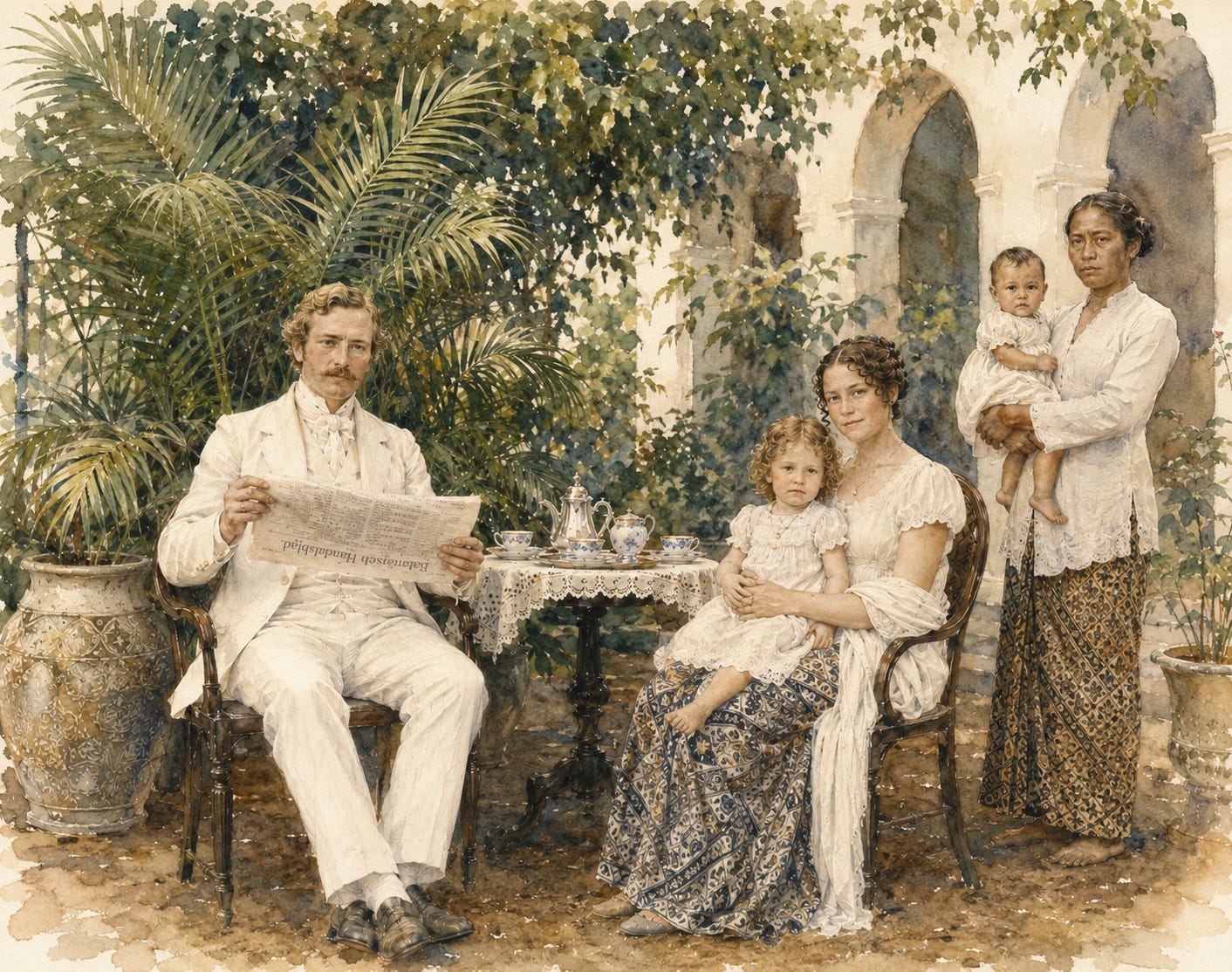
Carl Wilhelm von Franquemont (1800–1866) was born in Batavia to Carl Borel von Franquemont, a Württemberg-born military officer, and Maria Barbara von Hügel. After his mother’s and his father’s death a few years later, Willem was raised by baboes and a stepmother. During his lifetime, the Dutch East Indies underwent significant political change, including the British interregnum (1811–1816), while a growing Indisch-born population developed identities distinct from both Europe and Indonesia. In 1830 the Dutch also introduced the Cultivation System (Cultuurstelsel), requiring many Javanese villages to devote part of their land and labor to export crops for the colonial government, a system that greatly expanded both colonial administration and the Dutch economy. The following scenes trace his life and the gradual rooting of his family in colonial society.
Batavia, 1803
Three-year-old Willem and his older sister Lotte sit with Borel on the veranda.
Willem asks his father, “Will Mama not come back?”
Borel pauses and looks away as he thinks how best to answer.
“God has taken her.”
Willem is puzzled but doesn’t question further.
Later, with the baboe, Willem asks, “Where is Mama?”
“You cannot see her. But she can see you.”
“She can?” He looks around.
“She is part of everything. If you concentrate, you can feel her.” Dewi says as she presses his hand on his heart and pulls him onto her lap.
Willem puts his face against her soft blue batik sarong.
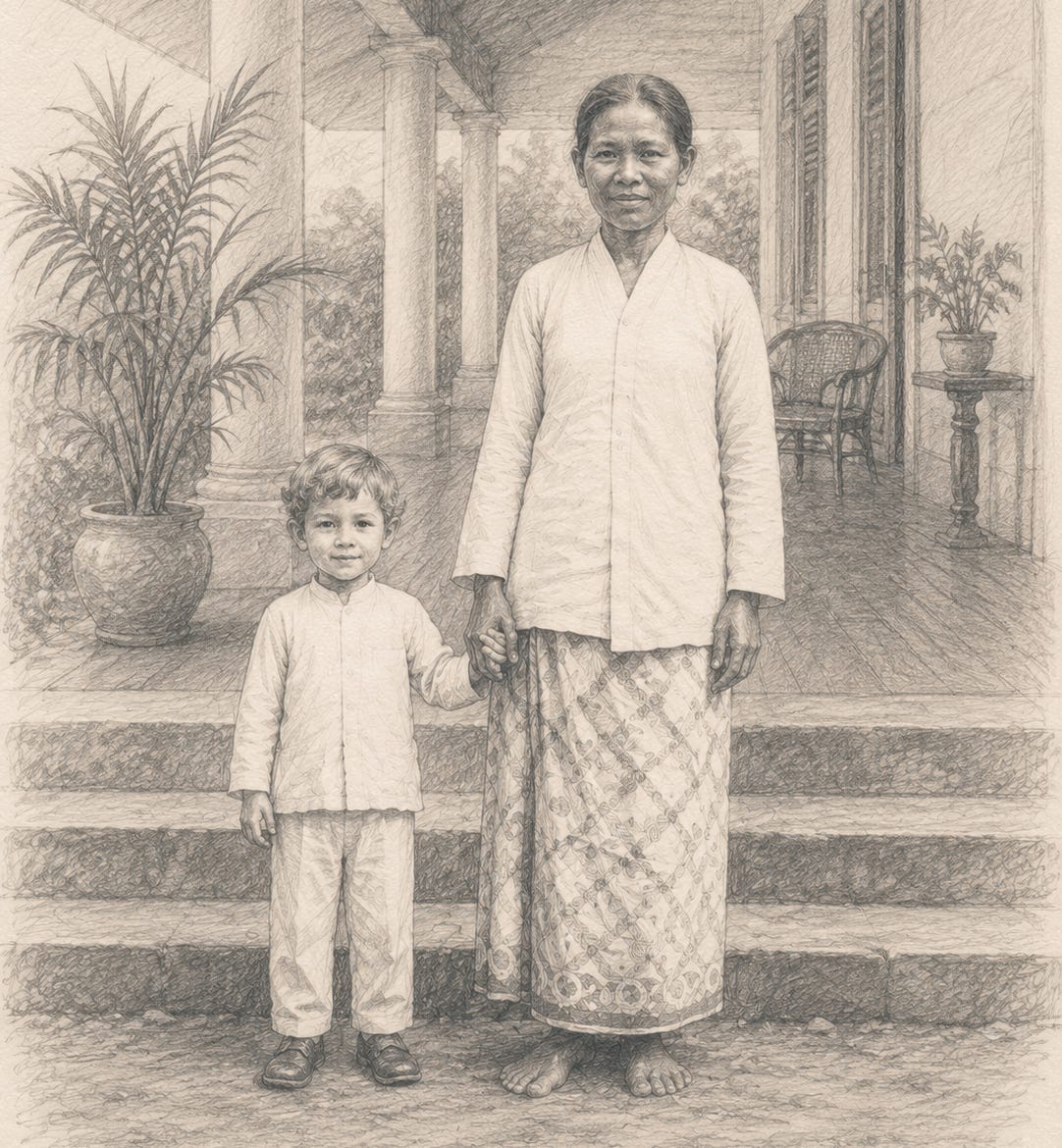
Surabaya, 1812
Ohm David has traveled a long way from Batavia to join them in Surabaya. He comes laden with gifts, not from Batavia but from Europe: An atlas for Willem, sheet music for Lotte, carved wooden soldiers for young Hendrik and a small, framed miniature of a European landscape for Henrika.
Later, Willem peers through the doorway into the room where Ohm David and his step-mother Henrika look over her investments. His Ohm is in his uniform with brass buttons, a sword at his side, and polished boots. It reminds Willem of his father, the way he talks with his hands. They’re similar, except that David sits less upright and laughs more often.
As Willem leaves the room, he hears his Ohm say to his step-mother, “Is this what you are setting aside for the boys’ futures?”
Before dinner, David sees Lotte playing the new music on the fortepiano, Willem studying his atlas, and Hendrik positioning the wooden soldiers. The children pause to have tea and sweet cakes just brought by Dewi.
“Dewi, Ada klepon?” Willem asks.
Dewi nods and leaves but does not back up as she once did.
Ohm David enters and sees the children enjoying their gifts. He says, “What do you say to Ohm David?”
Lotte and Willem say “Danke schön.”
Hendrik says, “Selamat.”
David then asks Willem to show young Hendrik the route from Java to Württemberg on the atlas.
Willem puts his finger on Java and then follows the route across the Indian Ocean, around Africa and then up the Atlantic to Württemberg in Europe. His finger lingers over Württemberg, as he says, “See how far? Halfway around the world!”
Little Hendrik forms a silent “Oh” with his lips.
“What do you know of your father’s and my home?” David asks.
Willem speaks of snow deeper than a horse’s knees, cadets marching at the Karlsschule, hunting in the forests, a castle overlooking the town.
As Willem speaks he inserts a Malay word not because he doesn’t know German but because the Malay word comes first.
David smiles. “You are becoming quite Indisch.”
That evening, after the children have retired, David and Henrika are gathered in the gallerij over coffee and sweets. Crickets chirp in the background and geckos click in the rafters as low conversation flows. They talk of the ship that arrived from Batavia, about the changes that may come with the new British administration and of the resident ball in Soerabaya.
After a lull in the conversation, David says, “What are your plans for the boy?” He looks at the fireflies as he turns his coffee cup. “He might still be sent to Württemberg.”
“There isn’t the money.”
“The family may help.”
“The seas are unsafe.” Henrika says, then adds, “And he would be thirteen before he arrives.”
©2026 Astrid Berg
To be continued…