
Where the Door Closes
Echoes Without End

Stuttgart / Ludwigsburg, 1727–1733
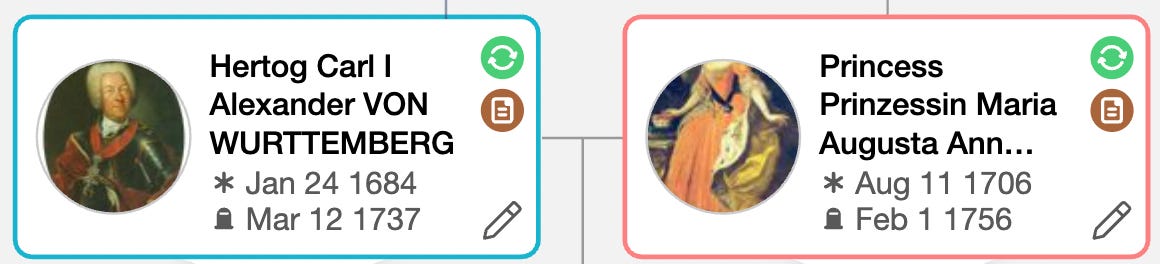
Maria Augusta of Thurn and Taxis was raised in Brussels, where her family’s control of the imperial post placed them close to the flow of political affairs. Her marriage to Duke Charles Alexander of Württemberg strengthened Catholic and Habsburg ties. She remained at ease within networks of correspondence and influence. The Duke, less inclined toward such exchange, watched these connections closely.
Augusta braces herself as her lady in waiting pulls tight the laces of the bodice. The young princess then steps into panniers followed by petticoats. All this to display the heavy blue silk gown--the same color as her eyes.
Augusta’s mother, Ludovika, chooses lace cuffs and pearls. The lace brushes lightly against Augusta’s wrist.
“Daughter, be agreeable. It’s the Habsburgs.”
Augusta’s smile fades into a grimace.
“Prince Alexander needs a Catholic wife.”
“I know, I know,” she responds with a sigh.
Ludovika adds the jeweled stomacher; the bodice tightens a fraction as it is secured. She adjusts Augusta’s sleeves and the back pleats. The fabric settles with a soft, contained rustle.
She then backs up to behold her promising daughter.
“Perfect,” her mother affirms.
Augusta pulls her body together and keeps her head high. She holds her breath a moment before releasing it.

Years later…
Maria Augusta sits, still in her evening gown, at a small writing table by the window overlooking the courtyard. Moonlight falls across the page at an angle. She breaks the red seal and unfolds a note from her brother. The wax gives with a soft snap.
Behind her, the door opens without sound, the polished floor reflecting light. A shift of air reaches her before the words do.
She knows it is him before he speaks. She does not turn immediately.
The princess inhales, puts the letter up her sleeve, and turns slightly.
“Who was that you were so engaged in conversation with?”
“You know very well Philip is a friend from childhood.”
“And that letter up your sleeve.” It is not a question.
Maria Augusta hands the note from her brother, the prince. She offers it before he reaches, as if the gesture were her own. Their hands do not touch.
The princess watches the duke as he reads. Although it’s a brief note, he takes his time.
“Personal matters,” she says before he can speak.
“You have many correspondents in Brussels.”
Where conversation moves more freely than here, she thinks, then says, “It is where I was raised.”
“And now you are here.”
Augusta nods, about to respond. Instead, she moves to rise and holds out her hand.
The duke lets the matter settle without pressing it further. He turns and walks away. He opens the door, pauses, then closes it with the same quiet with which it opened. The latch settles softly into place.
Augusta exhales. Her shoulders lower a fraction.
The information her cousin shared at dinner was more valuable than what is in the note.
.jpg)
Ludwigsburg Palace, c. 1738
Carl Eugene’s father, Charles Alexander von Württemberg, died nearly a year ago. At ten, Carl Eugene stands as duke in name, his authority held in trust. His mother, Maria Augusta of Thurn and Taxis, is granted a large allowance and recognized as co-regent, overseeing his education and conduct until he comes of age. Court advisors and tutors move around him, shaping what he will become. Beyond the palace, alliances shift within the Holy Roman Empire, where rank and loyalty are continually negotiated. Within it, order is maintained.
They live at Ludwigsburg Palace, where long corridors and formal gardens extend in measured lines, each space holding its place, the design echoing the order and display of Versailles. Past the last trimmed hedges, the hills held their own shape.
Carl Eugene at ten stands next to his desk at the window of his sleeping quarters in the east wing looking down on the axial paths lined with clipped hedges. The paths hold their lines without deviation. He hears the crunch of soldiers’ boots marching beyond his vision and moves close to the window to see them. He does not open it.
Light falls in a narrow band across the floor before reaching his heeled shoes. Behind him is a canopy bed with heavy curtains in hues of red brocade. The curtains hold the dim scent of wool and wax. The faint scent of rose water lingers near the door, thinner now than earlier in the day.
As the bell for the afternoon meal rings, Carl Eugene sighs and quietly opens the carved wooden door with gilt trim and enters the dining room. The heavy door clicks behind him. The latch settles with a dull, contained sound.
His tutor and governor stand behind their chairs at the round table waiting for the young duke to be seated. The boy pulls at his rough collar of his linen shirt. The linen rubs at his neck where the seam sits high. His waistcoat and breeches feel heavy on this warm day. Herr von Seckendorff watches.
The servant takes Carl Eugene’s bowl and puts down the second course. Steam lifts briefly, then thins above the plate.
Carl Eugene’s governor asks, “What did you learn this morning?”
The young duke recites the Latin, “amo, amas, ama…” He hesitates.
Monsieur Lefèvre, across from him, frowns, about to correct.
“Amat, amamus, amatis, amant.”
Languages were his better subjects. Carl Eugene, however, is preoccupied with the marching he heard earlier. He wants to ask about it.
“Name in French what is on your plate,” says the Monsieur.
“La soupe est chaude, Le poulet rôti, les navets,” he recites back.
The knife, given to him by his father, cuts smoothly into the chicken. Carl Eugene, not used to the fork, nearly drops it. The fork taps against the plate.
“Slow down,” says Herr von Seckendorff. The correction is given quietly, as if to keep it within the table.
Carl Eugene sets the knife back in place before taking another bite. The blade flashes briefly with a cold blue line.

Back in his study chamber, the young duke stands upright in front of his tutor. The air is cooler here.
“Recite the name of the Holy Roman Emperor. What were their duties and relationship to the Church authority,” Monsieur Lefèvre asks.
“Charles VI ruled as protector of the Empire and defender of the faith. He upheld the Church and maintained order among the estates.
Charles VII briefly held the crown, chosen by the electors in time of contest. He preserved the rights of the princes.
Francis I, husband to Maria Theresa, restored stability to the imperial office. He governed in accord with its laws and with the Church.
The Emperor is elected by the prince-electors. He must defend the Church, uphold justice, and preserve peace within the Empire.”
Carl Eugene recites evenly while thinking about being outdoors cantering his pony. His hands remain still at his sides. His pace quickens slightly at the final lines.
The scent of rose enters the chamber. The door opens and his mother the Princess enters. Air shifts in the room before she speaks.
“You sped up at the end.”
He lowers his gaze without moving his feet. Carl Eugene’s left hand closes into a fist.

His boots grind into the stone pathway leading to the stables. Carl Eugene’s pace quickens as he nears, smelling wet hay and manure, a servant trailing behind. The scent thickens closer to the stalls. He stops at the paddock to offer the black, Arabian stallion a carrot. Morro nibbles eagerly. His whiskers brush Carl’s palm. A blue sheen passes across his flank as he shifts.
Too young for the Arabian, Carl mounts his chestnut, Blitz. The horse master calls out the movements. His back stiff and upright, the young duke makes half turns, reversals and serpentines in the corral. The leather of the saddle is warm beneath him. Carl Eugene rides well and needs little correction.
At last, he and the riding master are beyond the palace grounds in the meadow in a measured canter, the rhythm settles through his hips. The line of the trail loosens into open ground. As they ride, the paths widen and then fall away. Beyond the hedges, the hills begin.
The wind is blowing in his hair and the air feels cooler beyond the walls. The pony snorts. Carl Eugene breathes more easily. His hands lower on the reins.
©2026 Astrid Berg