
Where the Sound Settles
Echoes Without End


Central Java, Singhasari–Majapahit Transition, c. 1200–1300
In Central Java in the centuries before the rise of Majapahit, village life moved between field, craft, and ritual, shaped by older animist traditions interwoven with Hindu-Buddhist cosmology. Sacred sites—candi of stone rising from the earth—marked places where offerings, music, and movement brought the visible and unseen into relation. Bronze instruments, tuned in sets, were played not as individual expression but as a shared pattern of sound. Dance and music gave form to stories already known—of balance and disruption, of rulers and wanderers, of the movement between worlds—drawn from court epics and local cosmologies alike. In courts, these forms were refined into ordered sequences that reflected hierarchy and power. In villages, they remained closer to the rhythms of daily life, woven into work, gathering, and ceremony.
Dawn
The bamboo weavers are up when the air is still cool and damp. The tree birds replace the chirping of crickets. Darma feels the bamboo for dryness and straightness, placing poles in slow, repetitive motion that tap as he stacks them against the wall.
Smoke rises at the pot makers where Maya stirs embers from the evening’s fire. Her rough hands lift damp cloth covering clay mounds.
More hearths are stirred. Morning light moves unevenly between the trees, and the sun softens the morning damp. Children pass between the dwellings. By sunrise, more villagers begin work.
Cutting begins at the bamboo weavers. Poles are measured by an arm’s length, cut with a quick downward force to size, then bent to test. Using a different tool, Darma shaves the outer skin. Rini sorts split bamboo by width, running fingers along edges to check for splinters and flexibility. Wira gathers the leftover shavings or offcuts.
Across the way, Karta is mixing clay with water. He uses his feet in a rhythmic motion to knead the clay. Squelching sounds bubble up as the air pockets pop.
Maya divides clay into portions twice the size of her fists. She wraps clay around into a coil, each round raising the height. Dipping her fingers into the water bowl, her hands move deftly, smoothing the coils into shape. Laras imitates her mother with scraps of clay.
Afternoon
Along the side of their house lie rows of partially formed pots, bowls, and ewers. Laras watches her mother place the containers in the sun to dry. Some pots are almost dry; others bulge or tilt, as if in stages of becoming. Seeing her father approach carrying vessels, she follows him to collect water from the stream. Wira is at the stream washing bamboo. He looks up and sees Laras.
He returns the clean, wet bamboo to his parents, sitting under a jackfruit grove. Darma and Rini weave the softened bamboo pieces over and under to shape baskets.
Laras joins her parents in the coolness of the jackfruit grove at the edge of the village. She peels the skin of a banana. Between the leaves, she sees the boy tapping his fingers on a strip of bamboo. Her hands still.
Clay Pot Firing
Maya is up early to clear out ashes and light the kiln. Leading up to the firing, Karta and his son Jaya gathered twigs, bamboo, and rice husks. Maya brings the vessels to the kiln, as Karta decides the order in which they will be fired. He places the wide-bellied jars himself. Laras and Jaya bring the smaller ones. Wira arrives carrying bamboo trays and hands them to Karta. He pauses at the edge of the work area, listening to the popping and crackling.
Karta feeds the fire, adding husks or reducing the bamboo fuel to control the temperature. At midday, the kiln is at peak heat. Laras goes to the stream to cool her skin. Wira is there fetching water. He hands Laras a cup to sip.
The kiln is left closed overnight. The following day, when the kiln has cooled, Karta opens it and removes the first pieces, tapping them to check the structure. Maya’s fingers feel for cracks and warping. Laras carries the finished pots to the shaded storage area.

Gamelan
The gamelan players are at the pendopo (open pavilion). Uneven, repeating metallic sounds of the bonang (kettle gongs) drift into the kampong, enticing villagers to leave their homes. Watching, Wira notes the rapid taps of Paman (uncle) Merta’s fingers on the kendang (hand drum). His eyes then follow his father’s hands crossing, then separating as he plays the bonang.
Sometimes Wira is allowed to sit next to Darma and handle the wooden tabuh (mallet). Some days he secretly goes to the pavilion, feeling all the instruments—the cool metal of the bonang and the smooth surface of the goatskin on the kendang. That’s his favorite. It’s too big for his lap, so he sits on one side and lightly taps it with his fingers. The elders know but say nothing.
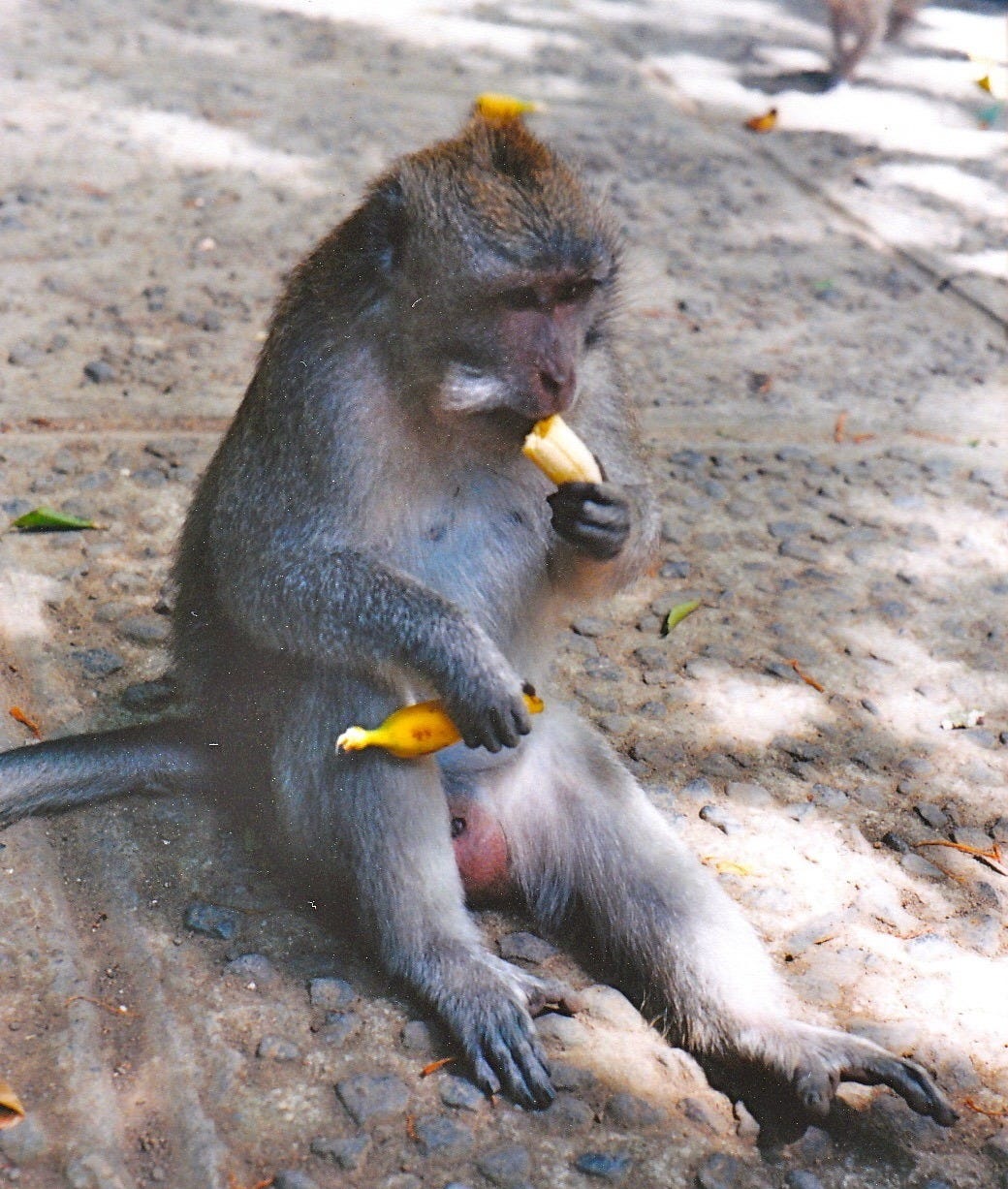
Macaque
Laras and Wira are walking along the path just outside the village. Wira reaches up and twists a rambutan from a branch. He peels back the red, hairy skin and bites into the white flesh. As he turns to hand the other half to Laras, a macaque drops from a tree and snatches the discarded skin. Wira flicks the fruit onto the path. The macaque dashes forward, takes it, and retreats a few steps. Laras laughs but doesn’t move. Wira crouches. The macaque lowers itself. Wira touches his head. The monkey does the same. Laras touches her nose, and the monkey ignores her. A rustle in the branches, and it’s gone. The torn rind lies in the dust, bright against the earth.
Voice and Drum
Wira sits at the edge of the circle, the kendang resting across his lap. With sharp tones from his fingers, he holds the pulse, feeling his father to his right. He listens for the moment to signal a change. The chiming of Darma’s bonang weaves around his syncopated beat. They pause. The gong strikes. They continue, tones settling over one another. Wira nudges the tempo. Only then do they glance at each other.
Laras sits outside the pavilion, listening with her eyes closed. She is with her family and others from the village. The tapping of the kendang weaves amidst the chimes of the bonang. The pulse reverberates in Laras’ chest. Without intending to, she sings. Her voice hovers above the sound. Wira looks over. He does not break the rhythm. The phrase opens. Her voice settles into it.
In time, Laras returns to the pavilion. This time, she sings with them.
The Invitation
Wira and Laras are with their families in the shade of the jackfruit grove eating. While handing a wedge of sticky jackfruit to Darma, Paman Tanu says, “Are you going to the gathering at the candi (temple)?”
Darma pauses. He nods.
Seeing Wira watch as he rolls a blue glass bead in his hand, Paman Tanu hands it to him.
Wira holds out his hand and then nods. With bead in hand, he looks at Laras.
Walking towards their huts, Wira pulls the bead from the fold of his waist cloth and rolls it in his hand. He puts the bead in a split piece of bamboo and rolls it back and forth, making a soft, hollow swish. It does not fall out. He hands the bamboo to Laras. She tries several times, but the bead pops out. Wira waits, not taking it back. Laras tilts the bamboo more slowly until it swishes smoothly. They both laugh.
That evening, Laras mentions the ceremony to her parents.
Toward the Temple
Laras hears quiet murmurs from others along the dirt path to the candi. She and Maya carry food offerings and small clay vessels, holding them close as the path narrows. Her father pulls the cart along the uneven ground. Pots shaking and rattling, he stops to check their condition.
Darma takes turns with Wira pulling a cart with the instruments.
As the midday heat rises, Wira and Laras walk side by side. Wira shortens his steps to match hers. His fingers tap lightly against his thigh. A pattern settles into their pace.
Laras hums, her notes moving along his rhythm. They continue walking.
The path narrows into a bamboo grove. They move closer without speaking. Laras feels the warmth between them.
The families rest under the shade at the edge of the temple grounds. Laras smells spiced dishes wrapped in leaves. People gather in clusters, some wearing kains (wrapped cloth) with softer drapes and tighter patterns. A few arrange offerings and set out vessels.
The two families walk up the stone steps to leave offerings of rice, fruit, flowers, and damar (incense). Gesturing, a temple attendant guides them to a lower stone where the offerings are placed.
Walking down the steps, the family joins those gathered in clusters where music is being played. Two young women stand with their upper bodies angled, their heads slightly tilted. Their fingers unfold with measured precision, their hands turning, their gaze held steady. The gong sounds.

Chosen
The gong is struck and continues to vibrate, its resonance lingering in the air.
At the edge of the pavilion, Laras sits. She notices the opening that follows—the space left by the fading sound. Wira holds the tempo within it, the kendang steady beneath his hands, the others aligning to him.
A court attendant enters near where she sits. He pauses at the edge, watching. After a moment, his attention settles on Wira. He steps closer but does not interrupt.
Wira does not yield the rhythm.
Laras senses the shift—the group drawing inward, tightening around him.
At the close of the cycle, stillness settles.
The attendant inclines his head to another man standing just beyond the pavilion—a court official, robed, waiting. A gesture is exchanged. The attendant approaches Wira.
“You are called,” he says quietly.
Wira rises and bows, his hands suddenly without purpose. He follows. A few words pass between Wira and the official, too low to hear. Wira bows again. When he turns back, his face is composed.
His eyes find Laras. Just briefly.
Something held. Not yet spoken.
In Time
Laras’ wet hands smooth the coils of her pot, humming as she works. Her son, Sekar, is kneading clay with his feet. His fingers pat his thighs between the pops of the air pockets in the clay.
Later at the stream, Laras sees Rini, now wrinkled and greying. They nod.
As Wira is wiping oil and fine dust from the metal gongs, a temple attendant carries a clay pot with an uneven mouth. She offers him water.
Later at the court ensemble while playing, the pace changes and a voice joins in. Under a smaller pavilion sits a court dignitary speaking quietly to someone. A servant is cooling him with a fan.

After Time
Laras is at the temple with Sekar to hear Wira play. Her hair is streaked with grey. Wira sees the boy’s hand moving in rhythm. After the ceremony, Wira goes to greet Laras.
She brings Sekar forward, her hand on his shoulder, and says, “My son, Sekar.”
“Would you like to try the kendang?” he asks and leads the boy to the instrument.
Sekar delicately touches the goatskin with his fingers.
Wira and Laras stand next to each other as they watch Sekar play.
Illness
Wira sits at the edge of the pavilion as the others play. He joins in holding the tempo for a time. He hesitates, missing a beat, then puts down his instrument and quietly leaves. After the rain season ends, a new kendang player takes Wira’s place.
Later, no one remembers when the children stopped walking that path together. Only that the days filled, and the sounds of the village grew more precise.
Laras sits with her family and other villagers under the jackfruit trees eating spiced vegetables with rice from a banana leaf. Jaya, the traveler, brings the news from court that Wira has passed away from a fever. Laras stops chewing and puts down her banana leaf. Her fingers close around the blue bead in the small, tied cloth.
The villagers surround the pavilion. Laras sits close. Younger players have replaced the older ones. Sekar has the kendang on his lap. The pattern returns. Laras watches.
©2026 Astrid Berg